
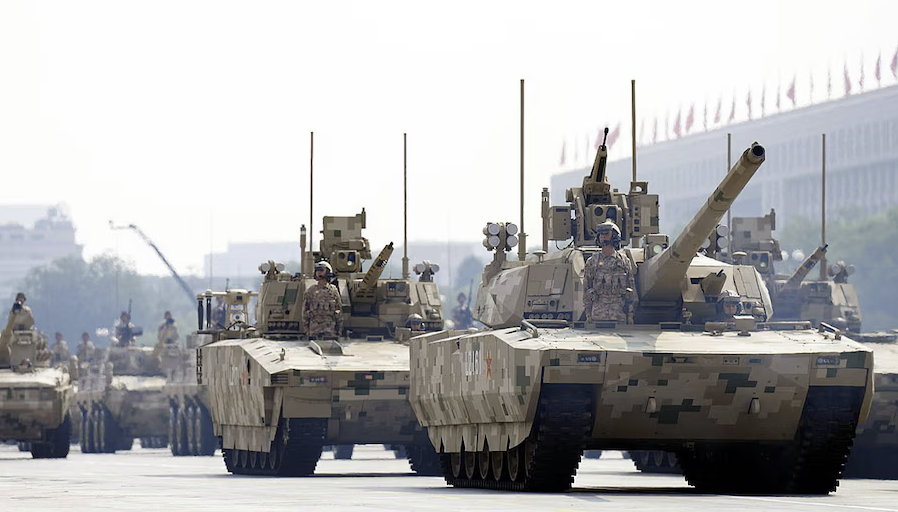
Chinese defence researchers have proposed a futuristic 60-tonne armoured vehicle powered by a small nuclear reactor and armed with a long-range electromagnetic railgun.
China’s military researchers have outlined a futuristic concept for a nuclear-powered main battle tank that could theoretically fire projectiles up to 450 kilometres away. The proposed vehicle would weigh around 60 tonnes and use a small modular nuclear reactor to generate electricity for its weapons and onboard systems.
The concept comes from a peer-reviewed research paper published in June 2026 in China’s Acta Armamentarii. Researchers from Inner Mongolia First Machinery Group and Beijing Institute of Technology contributed to the study. However, defence publication Janes notes that the paper presents a research framework rather than evidence of an active programme to build the nuclear-powered tank.
450-Km Range Railgun
At the centre of the proposal is a 50-megajoule electromagnetic railgun. Researchers estimate that the weapon could accelerate projectiles to around 3.5 kilometres per second, giving it a theoretical range of approximately 450 kilometres.
Unlike conventional tank guns, a railgun uses electromagnetic forces instead of traditional chemical propellants to accelerate a projectile. The system would require extremely large amounts of electrical energy to be delivered in a very short period.
A 10-megawatt-class small modular reactor is proposed as the vehicle’s main power source. The available electricity could also support high-energy systems and other electronic equipment.
China Has Proposed a Three-Stage Development Plan
The researchers have not suggested jumping directly to a nuclear-powered tank. Instead, their concept follows a three-stage development path.
The first stage, before 2035, focuses on integrating electromagnetic weapons with existing armoured platforms. The proposed system would use a 10-megajoule electromagnetic gun with a theoretical range of about 150 kilometres. A diesel generator and hybrid energy-storage system would provide the necessary power.
The second stage, from 2035 to 2045, would increase the weapon’s energy output. The proposed electromagnetic gun would reach 20 megajoules, with a projected range of around 300 kilometres. Researchers also envisage more advanced energy-storage technology during this phase.
The third stage, after 2045, would introduce the nuclear-powered version. The proposed vehicle would combine a compact nuclear reactor with a 50-megajoule railgun capable of a theoretical 450-kilometre range.
Nuclear Reactor Poses Major Challenges
Putting a nuclear reactor inside a tank presents enormous engineering problems. According to the reported concept, the reactor would need to fit within roughly two cubic metres, while radiation shielding would be limited to around three tonnes.
The vehicle would also need systems for power conversion, cooling and radiation protection. All of this equipment would compete for space and weight with the tank’s armour, weapons, ammunition and crew-protection systems.
Experts have questioned whether such a system would be practical on the battlefield. A military equipment expert cited by the South China Morning Post argued that the reactor, shielding and cooling requirements could make the vehicle too large and heavy to retain the advantages expected from a tank.
Not Yet a Battlefield Reality
Despite the dramatic specifications, the proposed tank remains a research concept. The study still requires further simulations and vehicle-level testing before any practical deployment could be considered.
The proposal also highlights a broader shift towards high-energy weapons and electrically powered military platforms. Researchers are exploring how future armoured vehicles could generate, store and distribute large amounts of electricity for weapons, sensors and electronic systems.
For now, there is no evidence that China has built or deployed a nuclear-powered tank. The 450-kilometre railgun vehicle remains a long-term concept, with the nuclear-powered stage placed beyond 2045 in the proposed roadmap.