
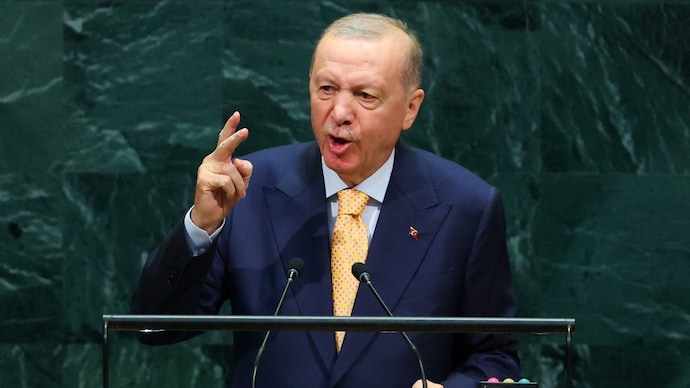
Turkish President Recep Tayyip Erdogan has once again stirred diplomatic controversy by raising the Kashmir issue during his address at the United Nations General Assembly (UNGA).
Speaking in the presence of Pakistani Prime Minister Shehbaz Sharif, Erdogan advocated that lasting peace in South Asia requires resolving all regional disputes, including Kashmir, through dialogue conducted strictly within the framework of the UN Charter and relevant resolutions.
Despite consistent and firm opposition from New Delhi, the Turkish leader has repeatedly utilized the UN platform to bring up Kashmir. The remarks notably follow just weeks after developments surrounding Turkiye’s alignment with defense cooperation frameworks involving Pakistan and Saudi Arabia.
Beyond the Kashmir rhetoric, Erdogan’s extensive address placed heavy emphasis on the dire humanitarian crisis unfolding in Gaza, strongly urging the global community to recognize Palestine as an independent, sovereign state. Noting Palestinian President Mahmoud Abbas’s inability to attend the General Assembly for a second consecutive year, Erdogan reaffirmed Turkiye’s commitment to championing the Palestinian cause.
He levied sharp criticism against Israeli military operations, reiterated his long-standing call for structural reforms within the United Nations Security Council, and appealed for an end to the international isolation of Turkish Cyprus.
Erdogan’s stance on Kashmir reflects a persistent pattern that intensified sharply following India’s abrogation of Article 370 in August 2019. At the time, his contentious remarks claiming millions were under blockade drew severe diplomatic pushback from India, which led to the cancellation of Prime Minister Narendra Modi’s planned visit to Turkiye and a scale-down of bilateral defense collaborations.
When similar statements were made in 2021, India’s Ministry of External Affairs firmly stated that such commentary reflected neither an understanding of history nor basic diplomatic conduct.
Despite intermittent periods of diplomatic normalization, Erdogan revived the dispute at the global forum, framing it under the lens of UN resolutions while welcoming local ceasefire developments. Rebuffing such external interventions, India maintains an unwavering position: the Union Territories of Jammu & Kashmir and Ladakh are, and will always remain, an integral and inalienable part of India.
New Delhi has repeatedly warned that third nations possess no locus standi to comment on its internal matters and that multilateral platforms should not be exploited to internationalize strictly bilateral issues.