
New Delhi: In a major political and legal escalation, Opposition leaders led by Leader of Opposition in the Lok Sabha Rahul Gandhi have filed a Public Interest Litigation (PIL) in the Supreme Court against the Election Commission of India (ECI). The petition challenges alleged large-scale voter deletions and irregularities during the Special Intensive Revision (SIR) of electoral rolls, alongside raised concerns over increasing administrative curbs on peaceful public demonstrations in the national capital.
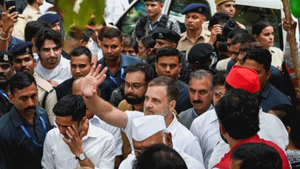
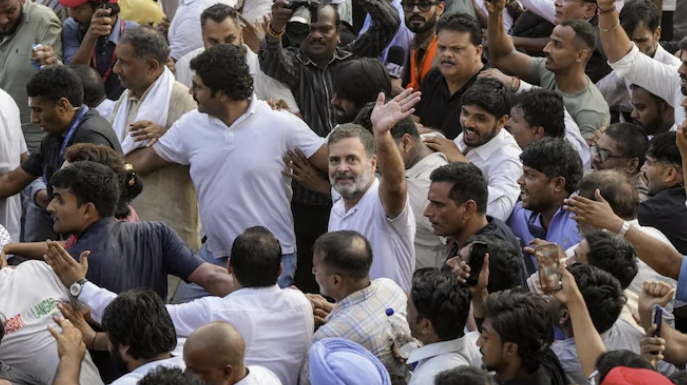
The legal action followed a high-profile ‘March for Democracy’ organized by the INDIA bloc. Opposition MPs, political leaders, and activists initially assembled at the Constitution Club before moving in four air-conditioned buses toward the Barakhamba Road junction. From there, they proceeded on foot toward the Supreme Court. However, Delhi Police halted the procession using heavy barricades at Bhagwan Dass Road. Following the blockade, key leaders including Rahul Gandhi and Samajwadi Party chief Akhilesh Yadav climbed atop a vehicle to address the gathered supporters and media.
The petition names 11 prominent Opposition figures as co-petitioners, representing a broad coalition across party lines. These include Rahul Gandhi, Congress President Mallikarjun Kharge, Trinamool Congress leader Saugata Roy, Samajwadi Party chief Akhilesh Yadav, RJD leader Tejashwi Prasad Yadav, Shiv Sena (UBT) leader Sanjay Raut, CPI(M) leader M. A. Baby, CPI leader D. Raja, Jharkhand Mukti Morcha leader Mahua Majhi, NCP-SCP leader Supriya Sule, and IUML leader E. T. Mohammed Basheer. The Election Commission of India has been cited as one of the four key respondents in the plea.
Prior to filing the petition, the Opposition leaders had requested an appointment to meet Chief Justice of India Surya Kant. However, the Chief Justice declined the meeting, stating that discussing matters slated for or currently pending before the Supreme Court in a private audience would violate the fundamental principle of separation of powers. Senior Advocate and Congress leader Abhishek Manu Singhvi clarified that the request was a standard written plea for an appointment rather than an attempt to pressure the judiciary, adding that the leaders immediately took the formal judicial route once advised. Singhvi also defended the public turnout at the march as a voluntary, spontaneous reflection of public dissatisfaction.
Addressing a press conference at the party headquarters, Rahul Gandhi aimed a direct critique at Chief Election Commissioner Gyanesh Kumar, calling on him to resign and “turn approver.” Gandhi asserted that while the Election Commission Chief had made a mistake, he was not the mastermind behind the underlying irregularities. He further claimed that around 200 government officers were actively communicating with the Opposition to share information regarding the electoral process.
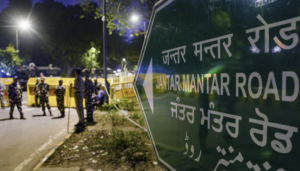
The demonstration also highlighted growing friction over protest spaces in New Delhi. The rally took place shortly after Delhi Police issued an order designating Ramlila Maidan, Burari Ground, and CBD Ground in East Delhi as exclusive protest venues, following the denotification of Jantar Mantar. Criticizing these spatial limits, Congress leader Jairam Ramesh accused the administration of stifling peaceful democratic expression, alleging that democracy was being reduced to an exercise in retaining power—a situation he described as “Demokursi.”