
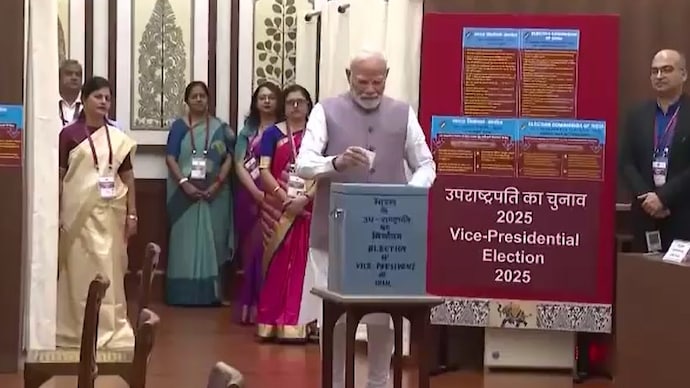
The stage is set for a high-stakes electoral contest as India votes today to elect its 15th Vice President, with polling underway in Parliament House from 10 AM to 5 PM.
The election, necessitated by the sudden resignation of former Vice President Jagdeep Dhankhar on July 21, 2025, citing health reasons, pits the ruling National Democratic Alliance’s (NDA) candidate, Maharashtra Governor C.P. Radhakrishnan, against the opposition INDIA bloc’s nominee, former Supreme Court judge Justice (Retd.) B. Sudarshan Reddy. While the numbers strongly favor the NDA, the opposition has framed the contest as an “ideological battle” to uphold constitutional values and democratic principles.
The electoral college for the Vice Presidential election comprises 781 members of Parliament—543 from the Lok Sabha and 238 from the Rajya Sabha (including 12 nominated members). A candidate needs a simple majority of at least 391 valid votes to win, with voting conducted via secret ballot under a proportional representation system using a single transferable vote.
The NDA, with approximately 426 MPs (293 in Lok Sabha and 133 in Rajya Sabha), holds a clear numerical advantage, further bolstered by support from non-INDIA bloc parties like the YSR Congress Party (YSRCP, 12 MPs) and AIADMK. In contrast, the INDIA bloc, along with allies like AAP and AIMIM, commands around 250–300 votes, falling short of the majority mark.
NDA’s Confidence and Strategy
The NDA’s candidate, C.P. Radhakrishnan, a seasoned BJP leader from Tamil Nadu and current Maharashtra Governor, is projected as a figure of administrative experience and political reliability. Prime Minister Narendra Modi, who cast the first vote today, expressed confidence in Radhakrishnan, stating on X that his candidature has “generated immense enthusiasm” and that he will be an “excellent Vice President” who will enrich the office with his wisdom.
The NDA has left no stone unturned, holding workshops like the Sansad Karyashala to train MPs on voting procedures and conducting mock polls to avoid invalid ballots. Top Union Ministers, including Piyush Goyal, Prahlad Joshi, and Shivraj Singh Chouhan, have been tasked with ensuring party discipline, organizing MPs into regional groups to streamline coordination.
Opposition’s Ideological Stand
The INDIA bloc, despite the numerical disadvantage, has rallied behind Justice B. Sudarshan Reddy, a 79-year-old former Supreme Court judge from Telangana, known for landmark judgments like declaring the Salwa Judum anti-Naxal militia unconstitutional in 2011. Reddy, backed by Congress, TMC, DMK, SP, and others, has positioned the election as a fight for the “soul of India.” In a video message to MPs, he urged them to vote based on “love for country” rather than party loyalty, emphasizing constitutional integrity.
Congress president Mallikarjun Kharge echoed this, calling for a united front to ensure Reddy’s victory as a defense of democratic values. The opposition held a mock polling session in the Central Hall of Samvidhan Sadan to brief MPs, instructing them to mark only “1” for Reddy to avoid errors.
Regional and Neutral Players
Three parties—Biju Janata Dal (BJD), Shiromani Akali Dal (SAD), and Bharat Rashtra Samithi (BRS)—have announced their intent to abstain, a move that does little to alter the NDA’s lead. The Telugu Desam Party (TDP), despite Reddy’s Telangana roots, has confirmed support for Radhakrishnan, as has YSRCP, consolidating the NDA’s southern backing. AIMIM’s Asaduddin Owaisi, supporting Reddy as a “fellow Hyderabadi,” has added a regional flavor to the opposition’s campaign, though it’s unlikely to shift the outcome significantly.
Cross-Voting and Symbolism
The secret ballot system opens a slim chance for cross-voting, with opposition leaders like Akhilesh Yadav suggesting that MPs voting “with their conscience” could lead to a surprise win for Reddy. Intellectuals and activists have also appealed for cross-voting, citing Reddy’s non-partisan judicial record. However, analysts consider a major upset unlikely, given the NDA’s tight coordination and party discipline.
The opposition’s strategy appears more focused on showcasing unity and signaling resistance to the ruling alliance’s dominance, particularly in the Rajya Sabha, where the Vice President serves as Chairperson.