
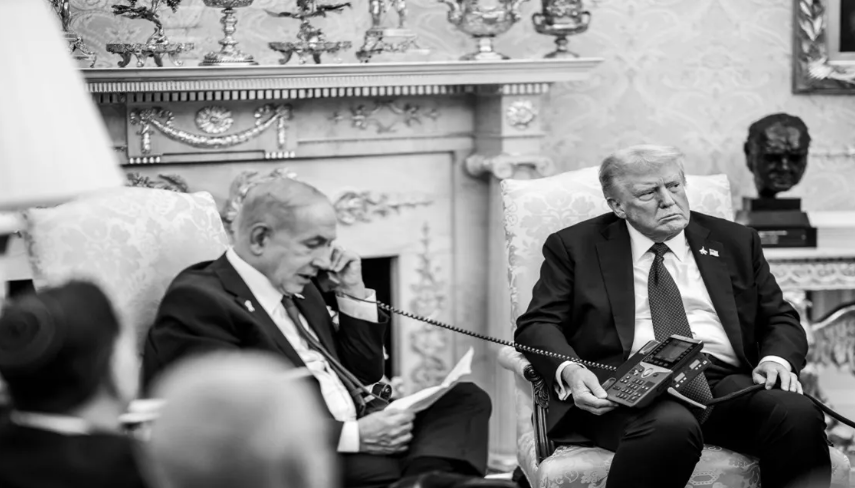
A black-and-white photo released by the White House has ignited online debate over whether Israeli Prime Minister Benjamin Netanyahu was reading from a scripted apology during a phone call to Qatar’s Prime Minister Sheikh Mohammed bin Abdulrahman Al Thani. Captured in the Oval Office on September 29, the image shows US President Donald Trump holding the phone to Netanyahu’s ear while the Israeli leader appears to glance at a sheet of paper in his hand. The call, facilitated by Trump amid his meeting with Netanyahu, followed Israel’s controversial airstrike on Doha three weeks earlier, which killed five people, including a Qatari security officer and the son of a senior Hamas figure. While no direct evidence confirms the paper contained a script, the optics have led to questions about Trump’s influence in engineering the damage-control gesture.
The Photo and the Phone Call
The image, part of official White House documentation, depicts a trilateral conversation involving Trump, Netanyahu, and Al Thani. According to the White House readout, Netanyahu “expressed deep regret” for the strike that “unintentionally killed a Qatari serviceman,” acknowledged the violation of Qatar’s sovereignty, and pledged no future attacks on its territory. Trump, who organized the call, later described it as a “heart-to-heart” to mend ties with Qatar, a key US ally hosting the largest American military base in the Middle East.
The apparent paper in Netanyahu’s hand has sparked speculation: Was it a White House-drafted script to ensure the apology hit the right notes? Reports indicate Trump had been pressing Netanyahu to apologize since the strike, viewing it as essential to resume Qatar’s mediation in Gaza ceasefire talks. One source familiar with Trump’s discussions noted he wanted the apology “sooner,” suggesting behind-the-scenes coaching. However, neither the White House nor Israeli officials have confirmed the paper’s contents, describing it only as part of the diplomatic exchange that led to a new trilateral communication mechanism.
Power Play in the Oval Office
The call occurred during Netanyahu’s White House visit, where Trump unveiled his 20-point Gaza peace plan, endorsed by Israel and several Arab states, including Qatar. Trump, a longtime Netanyahu ally, reportedly grew frustrated after the strike, calling it “not wise” in private and publicly stating he was “very unhappy about every aspect.” US officials claimed Israel notified them only as missiles launched, despite Axios reporting a prior briefing—highlighting tensions over the unilateral action.
For Trump, the apology served dual purposes: repairing US-Qatar relations strained by the attack on a close ally and clearing hurdles for his peace initiative, which Qatar had paused mediation on post-strike. Analysts see the photo’s staging—Trump literally holding the line—as a subtle display of leverage, positioning the US president as the regional dealmaker.
Israel’s Airstrikes on Qatar: What Happened?
On September 9, Israel conducted its first-ever strikes on Qatari soil, targeting a Hamas political leadership meeting in Doha’s Leqtaifiya district to discuss Trump’s ceasefire proposal. The attack killed five: four Hamas members and Qatari security officer Badr Al-Dosari, plus Khalil al-Hayya’s son, but spared the core delegation. Qatar condemned it as “state terrorism” and a “cowardly violation” of sovereignty, suspending mediation and drawing global outrage from the UN, Saudi Arabia, and others.
Netanyahu initially defended the operation as “fully justified” against October 7 architects, but faced backlash from hostage families fearing it endangered Gaza captives. Israel agreed to compensate the slain officer’s family, a key Qatari demand for resuming talks.
What Does Netanyahu’s Apology Mean?
The gesture signals Israel’s recognition of Qatar’s pivotal mediation role, bridging Hamas and the West despite mutual grievances like Al Jazeera’s coverage and Qatar’s Muslim Brotherhood ties. By apologizing, Netanyahu aims to avert broader diplomatic fallout, preventing adversaries like Iran and Turkey from exploiting Qatar’s rift with Israel. Qatar welcomed the “assurances” and recommitted to US-led efforts, potentially unlocking stalled hostage releases and Gaza peace progress.
Back home, Netanyahu faces criticism from his hard-right coalition for the perceived concession. The episode underscores shifting US-Israel dynamics under Trump, where alliance doesn’t preclude public course-corrections for strategic gains.