
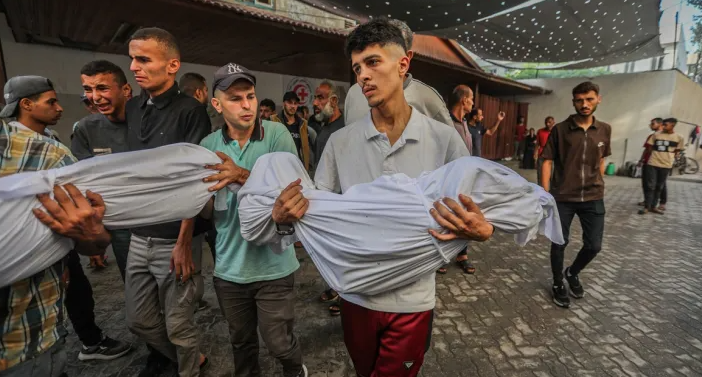
Israeli forces killed at least 39 Palestinians in Gaza on Monday, intensifying airstrikes and ground operations even as Hamas’s negotiating team began reviewing US President Donald Trump’s 20-point plan to end the nearly two-year war. Diplomatic sources confirmed to Al Jazeera that the proposal, unveiled during Trump’s White House meeting with Israeli Prime Minister Benjamin Netanyahu, has been shared with Hamas via mediators, though the group has yet to receive a formal written version and expressed skepticism over its implementation amid ongoing violence.
Escalation on the Ground
The latest strikes targeted areas across Gaza, including tent encampments and residential zones in Khan Younis and Gaza City, where displaced families sought shelter. Gaza health authorities reported the deaths occurred over the past 24 hours, contributing to a toll exceeding 66,000 since the conflict erupted following Hamas’s October 7, 2023, attack that killed around 1,200 Israelis and led to the capture of 251 hostages. Israeli military officials stated the operations dismantled Hamas outposts, confiscated weapons, and struck over 100 targets, including military structures and launchers, but did not immediately comment on civilian casualties.
The attacks underscore the fragile state of ceasefire talks, with Palestinians in Gaza questioning the plan’s feasibility as bombardment continues unabated. Smoke rose over Gaza City during the operations, exacerbating the humanitarian crisis in the devastated enclave, where widespread hunger and displacement affect over 2 million people.
Hamas’s Review and Concerns
Hamas spokesperson Mahmoud Mardawi told Al Jazeera the group was studying the proposal in good faith but highlighted a lack of direct consultation and guarantees for a permanent end to hostilities or full Israeli withdrawal. The plan demands the immediate release of all remaining hostages—alive and deceased—within 72 hours of acceptance, in exchange for 250 life-sentence Palestinian prisoners and 1,700 others detained post-October 7, including women and children. It also bars Hamas from any future governance role, mandates disarmament with amnesty for compliant members, and envisions Gaza as a “deradicalized, terror-free zone” under a technocratic Palestinian committee overseen by an international “Board of Peace” chaired by Trump.
Netanyahu, in a joint briefing with Trump, endorsed the plan as achieving Israel’s war aims: hostage recovery, Hamas’s military dismantlement, and prevention of future threats. He affirmed Israel’s commitment to the terms, while Trump warned that rejection by Hamas would prompt full US backing for Israel to “finish the job” and eliminate the group. Analysts note Hamas’s historical insistence on a complete Israeli pullout before full hostage releases, making acceptance unlikely without revisions.
International Reactions
The proposal has drawn cautious support from mediators and global leaders. Foreign ministers from Qatar, Egypt, Jordan, the UAE, Saudi Arabia, Indonesia, Turkey, and Pakistan welcomed Trump’s “sincere efforts” in a joint statement, pledging enhanced coordination. French President Emmanuel Macron urged Israel to engage resolutely and Hamas to release hostages immediately. However, the Palestinian Authority has voiced concerns over the plan’s alignment with Israeli interests, and no independent Palestinian statehood pathway is explicitly outlined beyond vague future conditions.
Trump described the initiative as a “critical step” toward regional peace, potentially extending beyond the Middle East, but experts like Steven Cook of the Council on Foreign Relations caution that Qatar must pressure Hamas, while Netanyahu faces challenges selling it to his security cabinet. As reviews continue, the death toll rises, testing the proposal’s urgency.