
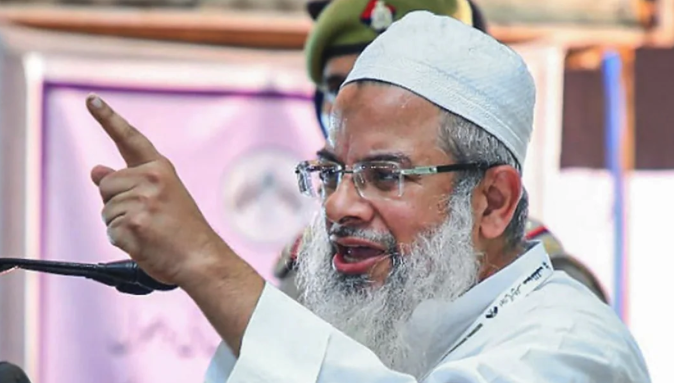
Maulana Madani on love jihad has ignited a fresh political storm across the country. Jamiat Ulama-e-Hind president Maulana Mahmood Madani rejected the term “love jihad” and accused several groups of spreading hatred through this narrative. He spoke at a community event and challenged the idea that interfaith relationships follow an organised conspiracy. His strong comments drew immediate reactions from political and legal circles.
Madani on love jihad continued his attack when he questioned the role of the Supreme Court during debates on religious freedom. He said the apex court should protect constitutional rights with more firmness. His remark triggered criticism from legal experts who saw his tone as unnecessary. Political leaders also accused him of provoking communal tensions. Madani dismissed these charges and said he spoke for equality and justice.
He argued that the phrase “love jihad” creates fear among families. According to him, some groups misuse the term and target young people. He said society should allow adults to choose their partners without pressure. Several community members supported his stand and praised his bold speech. Others warned that his words might deepen existing divides.
The BJP attacked Madani and said he covered up large-scale exploitation. Party leaders claimed that many states reported cases of forced religious conversion. They demanded clarity from the cleric on such issues. Opposition parties used the moment to question the government for politicising personal matters. Congress leaders said both sides should avoid extreme positions and respect the law.
Legal experts asked all stakeholders to wait for the Supreme Court to address the matter formally. They said the court already heard many petitions on “love jihad” laws. Some experts welcomed scrutiny of state policies. Others said constant pressure on the judiciary harms public trust.
The controversy around Madani shows how sensitive the subject remains. His remarks turned into a national debate within hours. Both supporters and critics now push stronger narratives. The issue will likely stay in the spotlight as political parties continue to use it ahead of coming elections.